


How Autonomous Systems Transform Finance and Supply Chain Management
Even when you aren’t working, your ERP system is putting in the overtime orchestrating a complex financial reconciliation, automatically adjusting inventory levels based on real-time demand signals, and even negotiating optimal payment terms with suppliers. Sound like science fiction? Welcome to the reality of autonomous ERP powered by Microsoft Dynamics 365 Finance & Supply Chain Management (F&SCM).
The days of treating your ERP as a glorified digital filing cabinet are over. Today’s AI-powered autonomous systems don’t just store your business data—they actively work to optimize your operations, predict challenges before they impact your bottom line, and execute decisions that would normally require hours of human analysis.
Did you know companies leveraging autonomous ERP capabilities are seeing 35% faster decision-making cycles and up to 50% reduction in manual financial processes? But here’s what’s even more compelling—they’re not just working faster; they’re working smarter.
The convergence of artificial intelligence, machine learning, and cloud computing has reached a tipping point where autonomous ERP isn’t just possible—it’s becoming essential for competitive survival. Organizations still relying on traditional reactive processes are finding themselves consistently outmaneuvered by competitors who can adapt to market changes in real-time.
The perfect storm of market pressures:
- Economic volatility demanding instant adaptability
- Supply chain complexity requiring proactive management
- Regulatory requirements evolving faster than manual processes can handle
- Customer expectations for immediate responsiveness
Microsoft Dynamics 365 F&SCM isn’t just keeping pace with these demands—it’s anticipating them.
What autonomous ERP looks like in practice

Smart financial operations that run themselves
Your accounts payable department now operates with great precision, but also with the intelligence of your most experienced financial analyst. Dynamics 365’s autonomous invoice processing doesn’t just scan and file—it analyzes payment terms, identifies early payment discounts, flags potential duplicate invoices, and even predicts cash flow impacts before executing payments.
The system learns from historical patterns and continuously optimizes approval workflows, automatically routing high-value invoices to the right decision-makers while processing routine payments without human intervention. This isn’t just automation—it’s intelligent orchestration that adapts to your business rhythms.
Supply chain that thinks three steps ahead
Traditional supply chain management is reactive by nature. Autonomous ERP flips this model completely. Microsoft’s AIalgorithms analyze supplier performance data, weather patterns, geopolitical events, and market trends to predict disruptions weeks or even months in advance.
When the system detects potential supplier delays in Southeast Asia, it automatically evaluates alternative sources, adjusts production schedules, and even places provisional orders to prevent stockouts—all before the original supplier confirms any delays. This proactive approach transforms supply chain management from crisis management into competitive advantage.
Financial forecasting that evolves in real-time
Remember the days of quarterly budget meetings where you’d spend weeks creating forecasts that were outdated before the ink dried? Autonomous ERP continuously updates financial projections based on real-time transaction data, market conditions, and predictive analytics.
The system doesn’t just tell you what happened last quarter—it predicts what will happen next quarter and automatically suggests corrective actions. When sales trends shift, the system immediately recalculates budget allocations, adjusts procurement plans, and alerts stakeholders to potential impacts on key performance indicators.
The Microsoft Dynamics 365 autonomous advantage
AI agents that actually work
Microsoft’s approach to autonomous ERP isn’t about replacing human judgment—it’s about augmenting human intelligence with AI agents that handle routine decisions while escalating complex situations to the right people at the right time. These agents learn from your business patterns and continuously improve their decision-making accuracy.
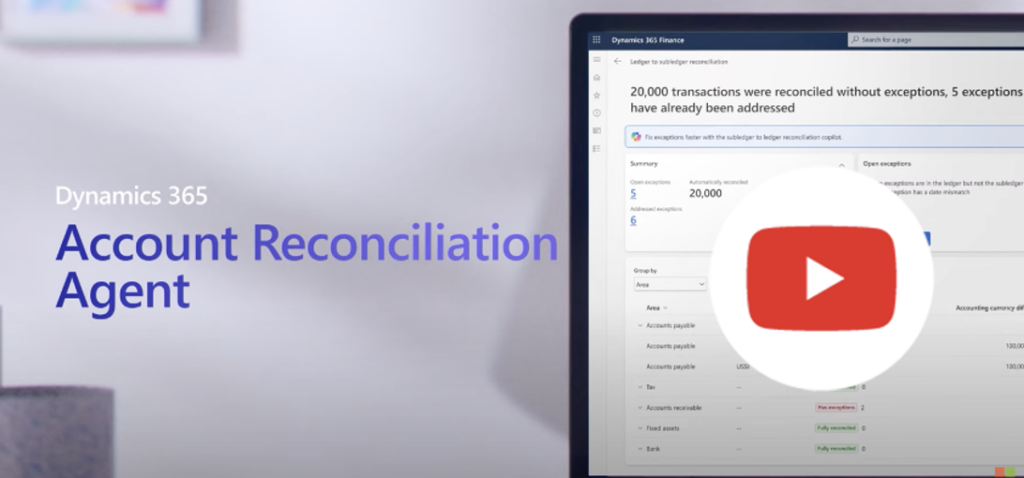
The Account Reconciliation Agent, for example, doesn’t just match transactions—it learns your organization’s reconciliation patterns and handles increasingly complex scenarios automatically. Over time, it reduces manual reconciliation workload by up to 80% while improving accuracy. Watch this minute long video on the Account Reconciliation Agent from Microsoft.
Integrated intelligence across all operations
One of the most powerful aspects of Dynamics 365’s autonomous capabilities is the seamless integration between finance and supply chain operations. When the system predicts a supplier payment delay might impact cash flow, it automatically adjusts procurement schedules, optimizes inventory levels, and even suggests alternative financing options.
This integrated approach prevents the siloed decision-making that plagues many organizations, ensuring that autonomous actions in one area support overall business objectives rather than creating unintended consequences elsewhere.
Real-world impact & numbers that matter
Organizations implementing autonomous ERP capabilities with Microsoft Dynamics 365 are seeing measurable improvements across key performance indicators:

- Decision-making speed: A study from Microsoft found that 30% of global organizations now use human-like interfaces in enterprise applications to gain insights quickly, improving decision velocity
- Process efficiency: Organizations experienced an average reduction of 27% in task processing times after implementing AI-infused ERP systems, with some accounting tasks seeing over 50% reduction in manual effort
- Forecast accuracy: AI can improve the accuracy of demand forecasting by up to 70% in ERP systems
- Cash flow optimization: AI can help reduce the time spent on financial forecasting in ERP systems by 50%
- Risk mitigation: AI can help reduce supply chain forecasting errors by 45% and companies utilizing AI-driven predictive analytics reported an 18% decrease in maintenance costs
These aren’t just efficiency gains—they represent fundamental competitive advantages that compound over time.
The autonomous ERP implementation challenge
The key to successful autonomous ERP implementation isn’t trying to automate everything at once but starting with strategic quick wins. Boyer’s approach focuses on identifying high-impact, low-risk processes where autonomous capabilities can deliver immediate value while building organizational confidence in AI-driven decisions.
We typically start with accounts payable automation or inventory optimization—areas where the business rules are clear, the data quality is good, and the impact is immediately measurable. Success in these areas builds momentum for more complex autonomous capabilities.
Building organizational trust in AI decisions
One of the biggest challenges in autonomous ERP adoption isn’t technical—it’s cultural. People need to trust that AI-driven decisions will support business objectives rather than create problems. Boyer’s change management approach includes transparency tools that let users understand how autonomous decisions are made and maintain override capabilities during the transition period.
Ensuring data quality for intelligent decisions
Autonomous systems are only as smart as the data they’re trained on. Boyer’s implementation methodology includes comprehensive data assessment and cleansing processes that ensure your AI agents are making decisions based on accurate, complete information. We also implement ongoing data quality monitoring to maintain system intelligence over time.
The network effect of autonomous operations
Here’s what makes autonomous ERP particularly compelling: the benefits compound exponentially as more processes become autonomous. When your financial forecasting, inventory management, and supplier relationships all operate autonomously in sync, you create a self-optimizing business ecosystem that continuously improves its performance.
Companies that implement autonomous ERP capabilities early gain a significant first-mover advantage. They’re building operational intelligence and competitive moats that will be extremely difficult for competitors to replicate quickly.
The cost of reactive decision-making
Traditional ERP implementations focus on recording what happened and analyzing historical trends. In today’s volatile business environment, reactive decision-making is becoming a liability. Companies that can’t adapt quickly to market changes, supplier disruptions, or regulatory requirements are finding themselves consistently behind the competition.
Autonomous ERP transforms organizations from reactive to proactive, enabling them to capitalize on opportunities and avoid threats that their competitors won’t see until it’s too late.
Why Boyer is your strategic autonomous ERP partner
Boyer & Associates brings unique value to autonomous ERP implementations because we understand both the technology capabilities and the business transformation required. Our team includes specialists in AI, machine learning, and business process optimization who can design autonomous capabilities that align with your strategic objectives.
We’ve guided organizations through hundreds of digital transformations, and we’ve seen firsthand how autonomous capabilities can revolutionize business operations when implemented with deep expertise in AI-driven transformations.
Autonomous ERP isn’t a one-time implementation—it’s an ongoing evolution. AI algorithms improve over time, new autonomous capabilities are regularly released, and business requirements change. Boyer’s partnership approach ensures that your autonomous ERP capabilities continue to evolve and improve long after the initial implementation.
Looking ahead: the autonomous enterprise
The organizations that will dominate their markets in the coming years are those that recognize autonomous ERP as a strategic imperative rather than a technical novelty. They’re investing now in the capabilities that will define competitive advantage for the next decade.
Microsoft Dynamics 365 F&SCM provides the foundation for this autonomous future. With Boyer as your implementation partner, you have the expertise and support needed to transform this vision into reality.
The question isn’t whether autonomous ERP will become the standard—it’s whether your organization will lead this transformation or be forced to catch up later. In today’s competitive landscape, that choice will determine your market position for years to come.
Ready to unlock the power of autonomous ERP for your organization? Contact Boyer & Associates today to discover how Microsoft Dynamics 365’s AI-powered capabilities can transform your finance and supply chain operations from reactive to autonomous. Because in the age of autonomous business, the companies that think fastest don’t just win—they define what winning looks like.