


When was the last time your production schedule went exactly as planned? If you’re like most manufacturing executives, unexpected equipment failures have become an unwelcome constant—disrupting operations, inflating costs, and keeping maintenance teams in perpetual firefighting mode. The good news? This reactive cycle doesn’t have to be your reality.
Today’s smart manufacturers are shifting from “fix it when it breaks” to “prevent it from breaking.” Microsoft Dynamics 365 Finance & Supply Chain Management is making this transformation more accessible than ever. Let’s explore how predictive maintenance can revolutionize your operations and why D365 is the platform to make it happen.
The predictive maintenance revolution: why now?
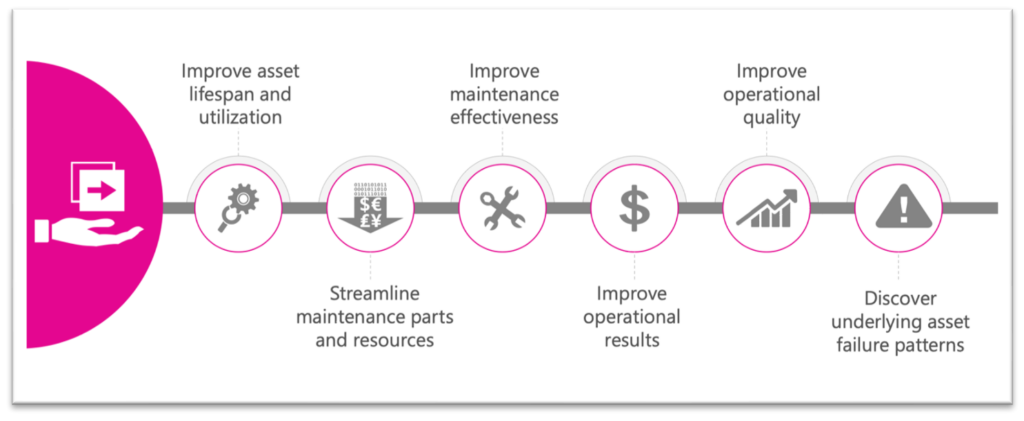
The industrial landscape is undergoing a fundamental shift. Gartner forecasts that by 2025, companies utilizing AI-driven predictive maintenance will achieve a 10–20% reduction in maintenance costs, while companies adopting predictive maintenance will see significant savings—cutting unplanned downtime by up to 50 percent and reducing maintenance costs by as much as 25 percent, according to Deloitte.
But here’s what’s really compelling: McKinsey states that by 2025, the positive economic impact of IoT on US factories will be between $1.2 and $3.7 trillion dollars. This isn’t speculative technology—it’s a proven strategy that’s transforming operations across industries.
Think of predictive maintenance as giving your equipment a voice. Instead of waiting for catastrophic failures, your machines can now communicate their health status in real time. With Dynamics 365 Supply Chain Management, organizations can proactively manage business-critical equipment using predictive, corrective, condition-based, and preventative maintenance.
At Boyer & Associates, we’ve witnessed this transformation firsthand across our client base. As a Microsoft Gold Partner with over 30 years of experience, we’ve guided organizations through this evolution, and the operational improvements are remarkable.
What makes D365’s predictive maintenance better?
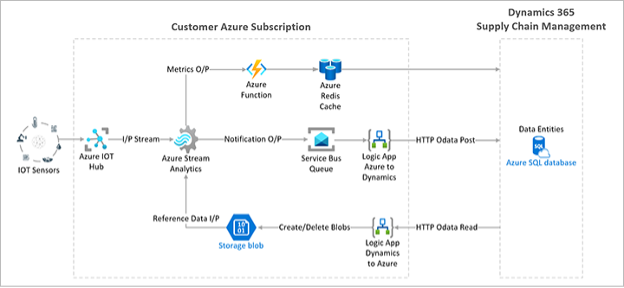
Microsoft’s Sensor Data Intelligence enables organizations to collect details from machines and equipment to update maintenance asset counter values in Supply Chain Management and drive predictive maintenance. This feature represents a significant advancement from traditional maintenance approaches.
The system supports multiple specialized scenarios:
- Asset downtime: Accurately track the efficiency of machine assets by using sensor data to track machine downtime
- Asset maintenance: Minimize maintenance cost and extend asset life by improving maintenance plans based on sensor readings of critical control points for machine assets
- Machine status: Ensure operation efficiency by using sensor readings to notify planners about machine outages and provide options for mitigating potential delays
- Product quality: Ensure the quality of product batches by comparing sensor readings for actual properties of each product batch, such as moisture, temperature, or custom-defined quality metrics
The power of real-time intelligence
Organizations leveraging IoT sensors throughout their supply networks, enhanced by features like Dynamics 365 Supply Chain Management’s Sensor Data Intelligence, can gain the ability to respond to issues as they’re developing, enabling quick, granular responses to in-transit events or quality deviations before they become major disruptions.
This creates what industry experts call “hyper-awareness”—a state where organizations move beyond basic visibility to achieve real-time operational understanding with predictive foresight.
Your D365 predictive maintenance roadmap
Step 1: Identify Your Critical Assets
Market leaders follow the 80/20 principle – addressing the most critical assets first to maximize ROI. Focus on equipment where downtime creates the highest business impact.
Step 2: Deploy Strategic Sensors
As of 2023, 62% of global manufacturers had already integrated IoT systems into their workflows, driven largely by the maintenance benefits. Common IoT sensors for predictive maintenance include vibration sensors, temperature sensors, pressure sensors, and acoustic monitoring devices.
Boyer’s expertise becomes invaluable at this stage. Our deep understanding of both Microsoft technology and industry-specific requirements helps clients design sensor strategies that deliver maximum value from implementation. We don’t just deploy technology—we architect solutions that address your unique operational challenges.
Step 3: Leverage AI and Machine Learning
The 2025 release wave 1 introduces several key enhancements: Demand Planning: Copilot, generative insights, and cell-level explainability to improve forecasting accuracy. Manufacturing: New features include optimized testing strategies and digitized records for quality management.
According to PwC, AI-driven predictive maintenance can increase failure prediction accuracy by up to 90% while reducing maintenance costs by up to 12%.
Step 4: Create Actionable Workflows
The system’s intelligence truly shines when predictions trigger automated responses. D365 can automatically generate work orders, order replacement parts, schedule maintenance during planned downtime, and alert technicians to developing issues.
Overcoming common implementation challenges
“Our infrastructure isn’t ready”
Many organizations assume predictive maintenance requires extensive infrastructure changes. The modern approach involves setting up the solution by using a simple onboarding wizard instead of manually installing and configuring components in Microsoft Dynamics Lifecycle Services (LCS).
“The technology is too complex”
Organizations can now deploy components on their own subscription, providing more flexibility to manage Azure components and configure, scale, and extend the solution as business logic that runs on Azure components.
Boyer specializes in simplifying complex implementations. Our 97% client retention rate reflects our commitment to ensuring every technology investment delivers measurable business value. We handle the technical complexity so you can focus on operational improvements.
Looking ahead: the future of maintenance
In 2025, predictive maintenance will shift from an emerging trend to a standard practice for asset-intensive industries such as manufacturing, logistics, and construction.
The technological evolution continues with:
- AI agents in applications and services that are set to revolutionize the way we work, with the range of capabilities for these agents constantly expanding beyond mere support—AI agents will increasingly be able to autonomously perform tasks, actions, and make decisions
- Drones and collaborative robots (cobots) performing inspections and minor repairs in hazardous areas, improving safety, speeding response times, and ensuring consistent monitoring
- Enhanced integration between IoT data and enterprise systems
Making it happen: your implementation strategy

Boyer brings unique value to this process. As a Microsoft Solutions Partner with deep expertise in Dynamics 365 F&SCM, we understand both the technological capabilities and the business transformation required. Our approach begins with understanding your specific operational challenges, then designing and implementing solutions that deliver measurable results.
Successful predictive maintenance implementation requires a strategic approach:
- Current state assessment: Evaluate existing assets and identify maintenance pain points
- Success metrics definition: Establish clear ROI expectations and operational goals
- Pilot program development: Start with high-value equipment to demonstrate value
- Scalability planning: Design for enterprise-wide expansion
The transition to predictive maintenance represents more than a technology upgrade—it’s a fundamental shift in operational philosophy. For strategic leaders, the shift to predictive maintenance isn’t merely a technical upgrade – it’s a transformation in how organizations approach asset management and operational resilience.
Organizations that embrace this transformation gain sustainable competitive advantages through reduced costs, improved reliability, and enhanced operational agility. The question facing manufacturing executives isn’t whether to implement predictive maintenance—it’s how quickly they can realize these benefits.
Ready to transform your maintenance strategy? Contact Boyer today to discover how predictive maintenance in D365 Supply Chain Management can revolutionize your operations and deliver measurable business value. Your equipment is ready to communicate—are you ready to listen?