


In the print industry, profitability is won or lost at every stage, from initial estimation to final delivery. Companies using integrated print ERP solutions are achieving remarkable results: reducing order processing time from 17 hours to just 7 hours (a 50%+ labor reduction) while dramatically improving margins.
DynamicsPrint is a specialized ERP solution built on Microsoft Dynamics 365 Finance & Operations, specifically designed for the print and packaging industry. At Boyer & Associates, we specialize in helping print companies implement and optimize DynamicsPrint, bringing deep expertise in both the Microsoft Dynamics ecosystem and the print industry.
This guide explores proven strategies for maximizing print job profitability across the complete production workflow.
1. Accurate Estimation: Setting the Foundation
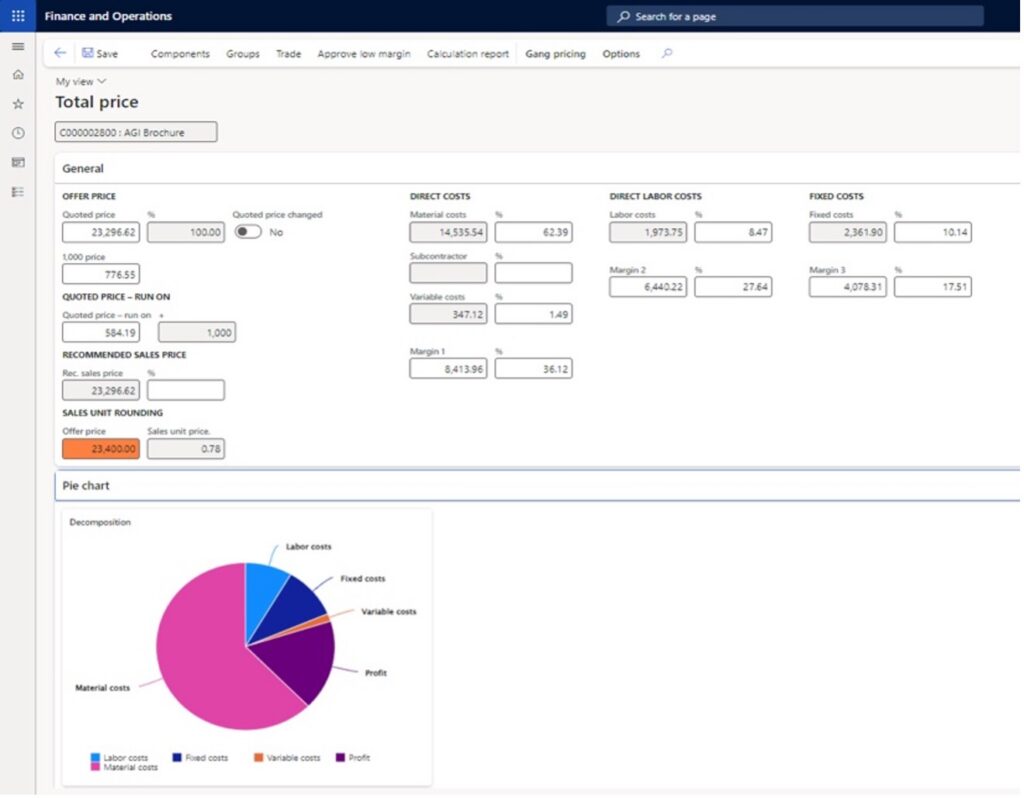
“Estimating has become an exact science,” says Angel Viveros of Foli De Mexico. That’s what happens when you connect estimates to real production data instead of outdated assumptions. Advanced job configurators pull actual costs from your shop floor (machine rates, material prices, labor costs), turning every estimate into a data-driven prediction rather than an educated guess.
2. Speed and Automation in Order Processing
Manual data re-entry between systems wastes labor, introduces errors, and delays production. When estimates convert to orders with one click, you eliminate errors and accelerate job starts. Novoprint dramatically improved processing times through integrated automation, converting approved quotes into production orders with complete specifications instantly.
3. Material Planning: Protecting Margins
Material waste kills profits silently. With DynamicsPrint, you achieve cost-efficient production through real-time material insights, automatically reserving materials, tracking consumption by operation, and flagging variances from estimates. The impact: better cash flow, reduced waste, and lower carrying costs, all contributing directly to improved margins.
4. Efficient Scheduling: Maximizing Resources
Smart scheduling drives profitability. One operation using DynamicsPrint reduced labor time from 17 hours 37 minutes to 7 hours 36 minutes per order through better scheduling and workflow optimization.
Key features include Gantt chart visualization with drag-and-drop scheduling, automated deadline planning with capacity checking, hyperautomation for intelligent job sequencing, and material reservations tied to production schedules.
Typical results: 30-40% reduction in makeready time, 20-25% improvement in press utilization, 50%+ reduction in late deliveries. Better scheduling equals better profits.
5. Real-Time Shop Floor Control
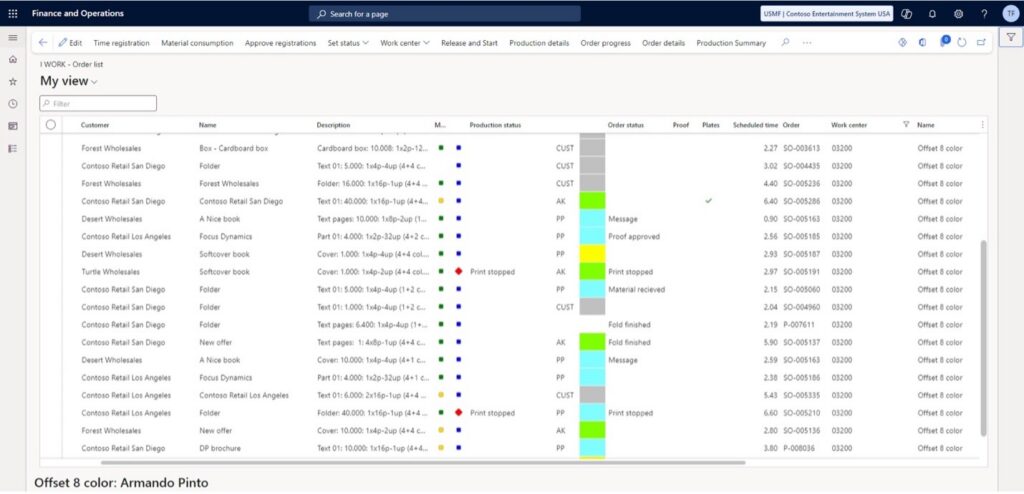
What’s running on press three right now? How does actual time compare to estimate? Is material consumption on track? If you can’t answer these questions instantly, you’re managing blind. Digital shop floor control gives your operators everything at their fingertips: specs, updates, routing visibility, automated time tracking. Problems get caught while they’re still small and fixable, not after they’ve burned through your margin.
6. Quality Control: Early Detection Saves Money
Quality issues cost exponentially more when caught late. Consider the progression: Preflight stage ($50-100), Proof stage ($200-500), Press check ($1,000-2,000), Final inspection ($5,000-10,000), Customer delivery ($10,000-50,000+). Integrated quality checkpoints throughout the workflow prevent errors from advancing and maintain estimated margins.
7. Inventory Optimization: Improving Cash Flow
DCM Canada manages inventory across 20 locations with centralized visibility showing what’s where. Automated reorder points trigger based on scheduled production, not guesswork. Just-in-time ordering means materials arrive when needed, not weeks early. The payoff: 20-30% reduction in carrying costs while maintaining perfect production flow. That’s working capital freed up for growth.
8. AI-Powered Automation and Predictive Insights
DynamicsPrint brings 23 AI-powered agents to your operation through Microsoft Copilot integration. The Predictive Maintenance Agent prevents finishing disasters by forecasting equipment failures before they occur. The Demand Forecasting Agent predicts inventory needs from historical patterns. The Intelligent Procurement Agent optimizes supplier selection automatically. The Financial Reconciliation Agent monitors profitability in real-time, flagging cost variances the moment actuals exceed estimates, giving you time to protect margins.
9. Smart Delivery Management
Integrated delivery management coordinates route planning, carrier selection, tracking, and proof of delivery through the same system managing your production. Delivery planning can start earlier, even before job completion, coordinating optimal timing and routing. No more rush shipping charges from last-minute coordination.
10. Analytics for Continuous Improvement
“The visibility into job statuses, P&L, and personalized dashboards have become essential to our business model,” says Mark Floyd of KP Corp, a $93M operation with 458 employees. Power BI integration provides self-service analytics, hundreds of visualizations, built-in AI that spots trends, and real-time dashboards. Every job becomes a learning opportunity.

11. Understanding True Customer Profitability
Not all revenue is equal. True customer profitability includes estimation time, service costs, delivery expenses, and payment terms, not just production costs. Integrated ERP systems track all costs by customer, revealing which relationships are truly profitable.
12. Strategic Capacity Planning
DCM doesn’t guess about capacity across their 20 facilities covering rotary/web, label, large format, commercial, digital, and security printing. They model it. Strategic capacity planning tools let them scenario-plan different growth assumptions, identify bottlenecks before they constrain delivery, and optimize work transfers between locations. Too much capacity bleeds overhead. Too little means missed opportunities.
13. Real-Time Financial Intelligence
Novoprint doesn’t wait until month-end to discover a job lost money. Real-time financial monitoring flags cost variances the moment actuals exceed estimates. Course corrections happen mid-job, while there’s still time to protect margins, not weeks later when all you can do is write off the loss.
14. System Scalability for Growth
DCM’s growth from one to 20 locations required scalable ERP. DynamicsPrint on Microsoft Dynamics provided a single platform with consistent processes, consolidated reporting, and role-based access, all supporting multiple product lines and pricing models.
15. Integrated Operations ROI
The power comes from integration. Print operations implementing integrated ERP commonly see:
- 50%+ reduction in order processing time
- 20-30% improvement in press utilization
- 15-25% reduction in material waste
- 30-40% decrease in administrative overhead
- Complete ROI within 18-24 months
Your Path to Maximum Profitability
Maximizing print job profitability requires optimizing every stage from estimation through delivery. The most successful operations build integrated systems that prevent problems, provide visibility, and drive continuous improvement.
At Boyer & Associates, we understand the print industry’s unique challenges. Ready to transform your print operations? Contact us today to discuss how DynamicsPrint can maximize your profitability.
Learn more at www.dynamicsprint.com.