


Your ERP system knows everything about your business, every invoice, every payment, every transaction. So why does your finance team still spend the final days of every period manually hunting down the gaps between what the subledgers say and what the general ledger shows? That disconnect has a fix (hint: it’s an AI tool), and it’s already built into Microsoft Dynamics 365 Finance.
What is the account reconciliation agent?
Available starting with Dynamics 365 Finance version 10.0.44, the Account Reconciliation Agent is an AI-powered agent that automates subledger-to-general-ledger reconciliation across four key financial areas: accounts payable, accounts receivable, bank, and tax. Rather than waiting until period-end to run static reports, the agent:
- Continuously monitors balances
- Identifies exceptions in near real time
- Suggests the actions needed to resolve them
This replaces the old reactive SSRS reporting model with a proactive, workspace-based experience that surfaces exceptions as they occur, not hours or possibly days later. As Microsoft’s documentation describes it, the agent “proactively notifies the finance team of any reconciliation issues” so teams can address problems right away.
How it works: a smarter reconciliation workflow
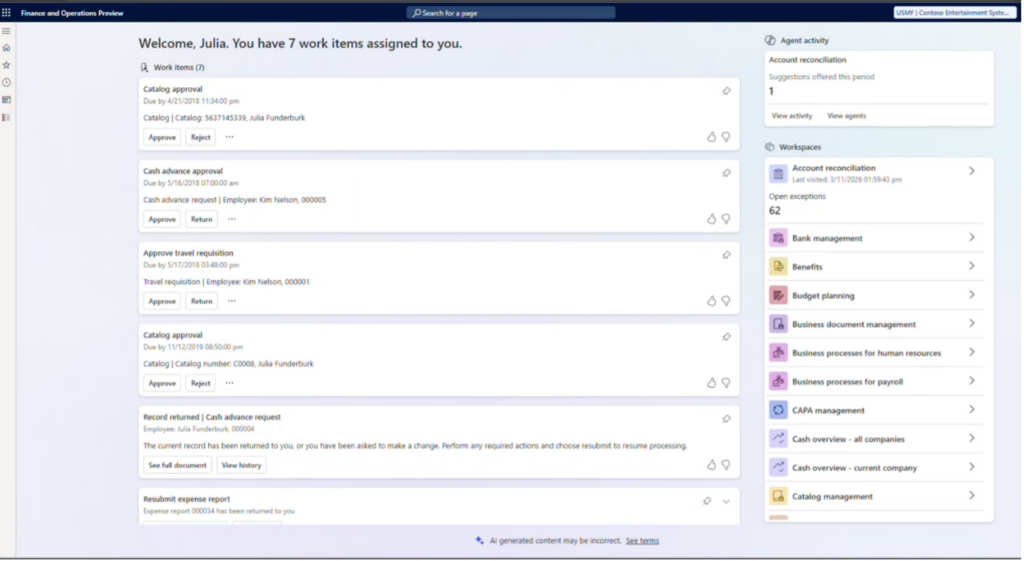
The agent lives inside a dedicated Account Reconciliation workspace in Dynamics 365 Finance. From there, your team gets a real-time dashboard showing reconciliation status across all covered modules, broken down by legal entity. The system automatically flags exceptions.
The agent is smart about what triggers an exception. Common scenarios include:
- A ledger account tied to a posting profile being used in a manual journal entry, bypassing the subledger
- A change to a vendor group or posting profile that creates a mismatch between subledger and general ledger balances
- Any amount discrepancy between accounting currency and reporting currency
Once an exception is identified, the resolution options available depend on the type of mismatch. If a transaction is in the ledger but not the subledger, your team can reverse the GL voucher directly from the workspace — no navigating back to the original transaction page — create an adjusting journal entry, link related transactions, or accept without change. If the exception runs the other direction (in the subledger but not the ledger), the options are to create a journal entry, match exceptions, or accept without change. That last option is particularly useful for small amounts or rounding differences that don’t warrant a corrective entry. Every action taken is logged in a full audit trail, giving you the transparency needed for both internal review and external audits.
Consider a mid-sized manufacturer running multiple legal entities. Mid-month, a member of the AP team modifies a vendor’s posting group, a routine administrative change. The old way, that change silently creates a mismatch between the vendor subledger and the general ledger that nobody catches until month-end, when the reconciliation report surfaces a discrepancy and the scramble begins. With the new Account Reconciliation Agent running on a scheduled hourly cadence, that same mismatch is flagged as an exception within the hour. The agent identifies the transaction, displays the accounting currency difference by legal entity, and suggests a corrective action. What would have been a stressful end-of-period detective exercise becomes a five-minute resolution in the middle of a regular workday.
From automation to intelligence with Copilot-powered suggestions
The agent is more than a monitoring tool, it’s also a learning one. As Microsoft’s 2025 Release Wave 1 documentation confirms, the Copilot-powered agent evaluates exceptions and recommends the most likely corrective action for each one, reducing the judgment calls your team needs to make. And over time, it learns from past resolutions moving progressively toward more autonomous issue resolution.
The reconciliation schedule is also fully configurable. Using Microsoft’s Process Automation framework, you can set the agent to run hourly, daily, or aligned with your fiscal periods, whatever cadence keeps your financial records most accurate.
Think about what your finance team could do differently if month-end reconciliation wasn’t consuming days of manual work. The Account Reconciliation Agent shifts that time from low-value data matching to high-value analysis: variance investigation, strategic forecasting, business partnering.
Reconciliation exceptions are caught as they happen, not at period-end. Audit readiness is built in, with complete activity logs tied to each voucher. And financial data stays current, supporting better decision-making throughout the month, not just after the books close.
Looking ahead, Microsoft’s roadmap for the agent includes expanded module coverage (Fixed Assets, Project Accounting, Intercompany, and more), higher-accuracy matching logic, and a path toward fully autonomous end-to-end reconciliation flows. The agent you deploy today is the foundation for a continuous financial close tomorrow.
Making the most of AI account reconciliation with Boyer
Features like the Account Reconciliation AI Agent are only as effective as their implementation. Enabling the agent in Feature Management is straightforward; configuring it to reflect your actual posting profiles, legal entities, and reconciliation cadences is where deep Dynamics 365 expertise matters. We’ve helped our clients reduce administrative tasks by up to 40% with proper configuration of the Microsoft AI tools.
Whether you’re already on Dynamics 365 Finance and want to activate these new agents, or you’re evaluating F&SCM for the first time, Boyer can help you move from where you are to where you want to be.
Ready to take month-end reconciliation off your team’s plate? Contact Boyer today to learn how the Dynamics 365 Finance Account Reconciliation Agent can transform your close process.