



Most technology decisions look the same on day one. The real difference shows up years later, after the organization has grown, the requirements have shifted, and the platform either bends with the business or breaks under it.
That difference almost always comes down to design. Microsoft’s modular platform for AI changes how organizations scale, integrate systems, and apply Copilot across the business.
A planned city, not a strip mall
There are two common ways organizations build their technology environment. It’s sort of like two ways to build a downtown.
The first is like a strip mall with a row of separate storefronts. Each one has its own parking, its own utilities, its own security, its own everything. They sit next to each other, but they don’t share anything. When a new tenant arrives, they build from scratch. When the city wants to add a transit line, every storefront has to be retrofitted one at a time, if it can be done at all.
Similarly, organizations often rely on a collection of point solutions. They have a CRM here, ERP system there, with analytics, security, and reporting layered in separately. Each system solves a specific problem, but none are designed to work together by default. Integrations pile up. Data fragments. Every new capability becomes its own project.
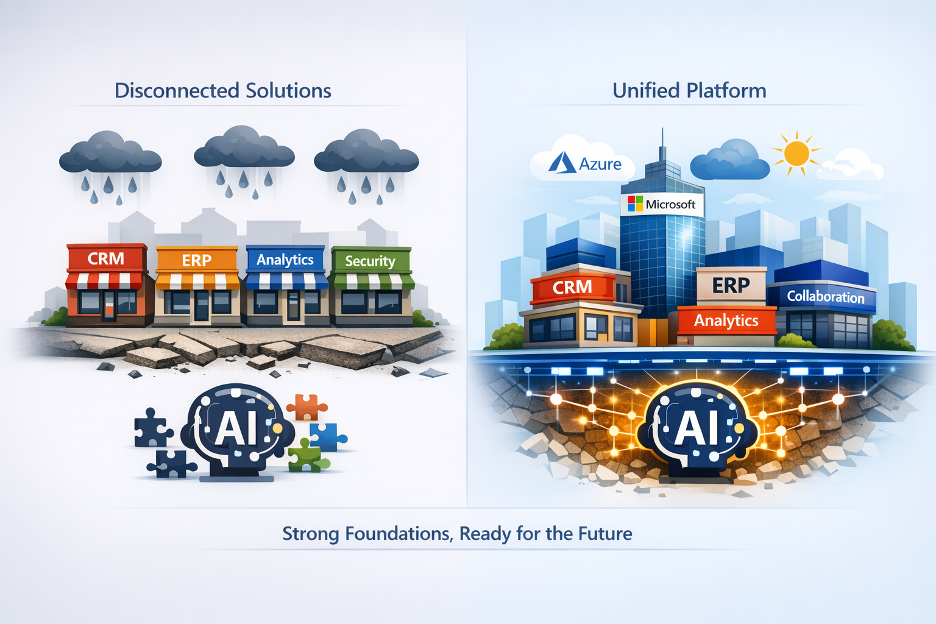
A planned city is different. There are shared roads, shared utilities, shared zoning, shared emergency services. Each building is still its own thing, a hospital or a school or a library or a coffee shop, but they all plug into a common foundation. New buildings go up faster because the infrastructure is already there.
And for an organization, a shared foundation for their technology means that systems connect through common identity, data, and security models. With Microsoft’s modular platform for AI, each application still does its job, but it plugs into something larger. New capabilities don’t start from scratch. Instead, they extend what’s already there.
Now imagine you want to add something genuinely new to each. Let’s say we want to add an AI system that routes ambulances, deliveries, and commuters in real time.
In the planned city, it works. The system can see traffic, hospitals, schools, weather, and deliveries. Everything connects, so it can coordinate everything. The city gets smarter.
In the strip mall, the same AI has nothing to see. There are no shared roads to optimize, no shared data to read. The system can’t do its job. It’s not because the AI is bad, but because there’s nothing for it to coordinate.
This is the difference between Microsoft’s ecosystem and a stack of disconnected point solutions. The distinction matters more than ever as organizations look to apply AI in meaningful ways.
A platform, not a portfolio
Dynamics 365, Microsoft 365, the Power Platform, and Azure aren’t separate products under one brand. They’re built on a shared data model with a shared identity layer, a shared security model, and a shared AI fabric. Each piece works on its own. Together, they compound.
That means an organization can start with what it needs now, such as finance or operations. It can then add fundraising, analytics, portals, automation, or custom apps later, without rearchitecting the core of what’s already running. The platform grows as the organization evolves. Capabilities click in. Data already flows. Security already follows the user.
This is what scalable actually looks like in practice. It’s not that the system “can handle more transactions,” but “it can handle more of your business, on the same foundation, without starting over.”
AI is only as good as the systems beneath it
AI is not a feature you bolt on. It’s a capability that depends on context, and context lives in your data, your processes, and your people.
An AI assistant that only sees one application can answer questions about that application. An AI assistant that sees finance, fundraising, operations, and collaboration together can answer questions about the organization. That gap is what separates a useful tool from a force multiplier.
Microsoft’s modular design is what makes the second scenario possible. Because the systems share data and security by design, Copilot and agents can reason across them by default. The work to enable AI readiness on the Microsoft platform across the business has already been done. Customers inherit it.
Organizations on a patchwork of disconnected point solutions face a tough challenge: How do we make AI useful when our data is scattered, our security models don’t agree, and every integration is its own project? Organizations on a unified ecosystem get to ask a more strategic question. Where can AI create the most impact next?
Growth without sprawl
The other quiet advantage of modular design is governance. When every new capability comes from the same platform, it inherits the same controls. Permissions, compliance, auditability, and lifecycle management all carry over. Adding a new app doesn’t mean adding a new risk surface, a new admin console, or a new vendor relationship.
This lets organizations expand intentionally. New capabilities show up where staff already work. Reporting stays consistent. IT doesn’t spend its weekends stitching systems together.
And as AI moves from experimentation to infrastructure, this becomes more valuable. The organizations that will get the most out of AI over the next three years aren’t the ones with the most tools. They’re the ones with the most coherent foundation.
Foundations matter when things change
Technology shifts tend to punish complexity and reward strong foundations. As platforms evolve faster, the old feature/functionality debate breaks down. What looks differentiated today becomes table stakes in months.
Microsoft’s modular platform for AI does real work behind the scenes. It’s the reason AI feels practical inside this ecosystem instead of theoretical. Data, security, and intelligence are shared by design. Growth happens by adding, not replacing. And when the next capability arrives, the platform is ready.
That’s the kind of foundation that holds up, not just for today’s needs, but for whatever comes next.