


The estimate came together perfectly. The numbers worked. The customer approved the quote. And then, somewhere between that signed approval and the invoice, the margin quietly disappeared.
If that pattern feels familiar, you’re not alone. For commercial printers, packaging companies, and label manufacturers, the estimate is often the most controlled moment in the entire job lifecycle. Everything after it is where profitability gets decided, and where most print operations have the least visibility.
Key Takeaways
- Print profitability most commonly erodes during the handoff from quote to production order, during scheduling, on the shop floor, and in post-job analysis.
- The root cause is disconnected systems that require manual re-entry or allow data to go missing between stages.
- DynamicsPrint® on Microsoft Dynamics 365 addresses each stage by connecting estimating, order management, scheduling, shop floor control, and analytics in a single platform.
Why the Estimate Isn’t the Problem
Estimating in the print industry has come a long way. Advanced job configurators, sophisticated imposition tools, and price list management have made it possible to produce accurate, detailed quotes that account for materials, labor, machine time, and contribution margins before a single sheet runs.
The estimating module in DynamicsPrint®, for example, lets teams analyze critical information before bidding, tying estimates directly to quotations, freezing calculations to prevent inadvertent changes, and performing cost analysis across different quantities.
Foli De Mexico, a commercial print and packaging operation, implemented DynamicsPrint® to bring precision to their estimating workflow:
“DynamicsPrint with Imp is the heart of our planning estimating and imposition system. Estimating has become an exact science. Our young estimators can deliver accurate plans as many years of an experienced estimator would.”
— Angel Viveros, Estimation and Planning Manager, Foli De Mexico
That kind of precision is achievable. The problem isn’t the estimate. It’s what happens when that estimate moves into production.
Where Print Job Profitability Actually Breaks Down
The Handoff from Quote to Order
The first vulnerability is the handoff. In many print operations, the quote lives in one system while the order lives in another. The detailed assumptions baked into the estimate, specific paper stocks, run speeds, makeready time, finishing sequences, don’t always survive the translation into a production order.
When the two aren’t connected, the calculation that should drive production decisions gets rebuilt from scratch or skipped entirely. Labor time gets estimated loosely. Materials get over-requisitioned. And the contribution margin that looked healthy on the quote quietly shrinks.
A fully integrated system eliminates this by copying the calculation directly into the order. When data changes, the entire job recalculates automatically, with new amounts, new prices, and no manual re-entry.
Scheduling That Ignores Real Capacity
Even when the order is accurate, poor scheduling erodes margin in ways that never show up on the estimate. Overloaded work centers. Unoptimized job sequencing. Makeready time that doubles when similar jobs aren’t batched together. Material that gets reserved too early, or not at all.
Gross planning that checks actual capacity against deadlines, Gantt-based fine planning, and intelligent job batching, matching jobs with the same paper and the same colors, can meaningfully reduce production costs. DynamicsPrint® refers to these opportunities as “lifts,” actions that directly improve profit. The system surfaces them and ranks them by size, so teams can act on the biggest cost reductions first.
The Invisible Cost of Shop Floor Disconnection
Shop floor disconnection is where the largest unplanned cost variances in print manufacturing occur. When press operations are not reporting back to the production order in real time, there is no alert when a job runs over on time or consumes more material than estimated. By the time anyone notices, the job is done and the loss is locked in.
With real-time shop floor control, every start, stop, and material consumption event posts automatically to cost accounting as Work in Progress. Customer service can see whether a job is on track. Planners see actual WIP rather than scheduled estimates. The supply chain knows exactly when materials need to be released.
That real-time loop, from the press to the cost ledger, is what turns “we think this job is profitable” into “we know it is.”
The Budget vs. Actual Gap Nobody Measures
Most print operations do a post-job review eventually. Few do it systematically. Even fewer connect those findings back to future estimates or use them to identify patterns across jobs, customers, or equipment.
The result is that the same margin-eroding scenarios repeat. A particular press runs slower than standard on certain substrates. A specific customer always requests last-minute changes. A finishing process consistently consumes more materials than estimated. Without order calculation compared against actual costs, and the ability to build KPIs and Power BI reporting on top of that data, those patterns stay invisible.
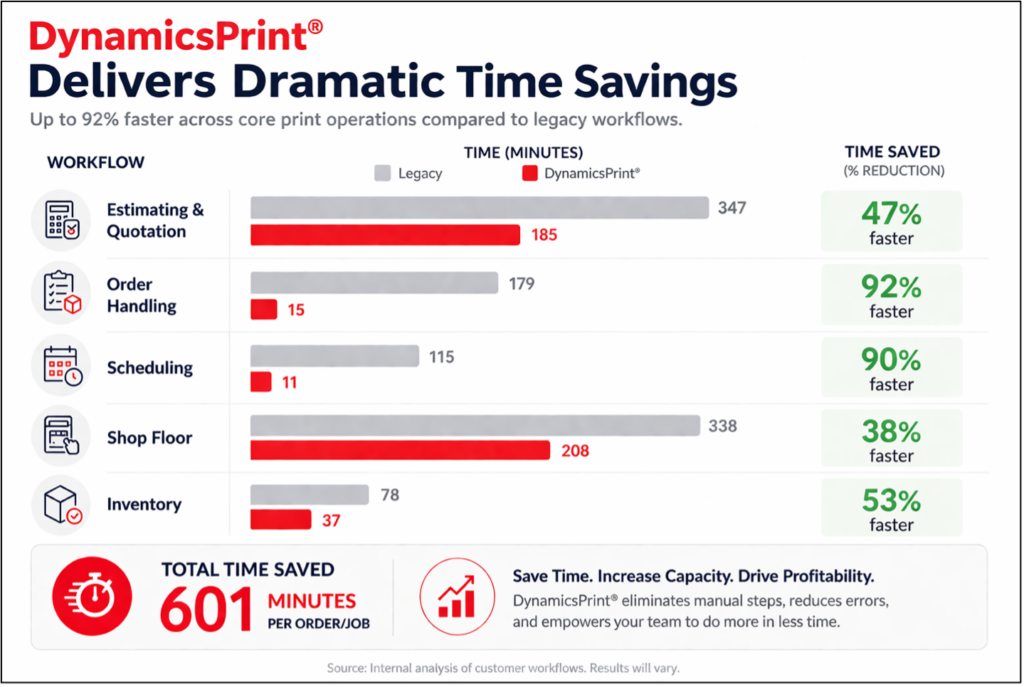
According to DynamicsPrint®’s internal analysis of customer workflows, operations running on the platform average 601 minutes saved per order across estimating, order handling, scheduling, shop floor, and inventory workflows, with individual process improvements ranging from 38% to 92% faster than legacy systems. Individual results will vary.
The Real Cost of Disconnected Systems
Each of the breakdowns above is made worse by the same root cause: systems that don’t talk to each other.
When estimating, order management, scheduling, shop floor control, inventory, and finance each live in separate platforms, data either gets re-entered slowly and with errors, or it doesn’t move at all. Teams operate on assumptions rather than current information. Managers make decisions from reports that are days old.
DCM Canada, a 2,000-person print operation that, according to DynamicsPrint®’s published case study, serves 70 of the top 100 largest corporations in Canada, ran on seven different operating systems before implementing DynamicsPrint® on Microsoft Dynamics 365.
“DynamicsPrint®’s expertise in the system and the industry were instrumental in ensuring the configurations were done properly. The approach followed was very well structured to ensure the team worked from the basic setups to the more complex setups at a pace that was manageable and retainable.”
— Karen Redfern, VP of Operations Technology, DCM Canada
What Closing the Print Profitability Gap Looks Like
Print operations that consistently protect margin from estimate to invoice using DynamicsPrint® on Microsoft Dynamics 365 share four operational characteristics:
- A single source of truth from estimate to invoice. The calculation that drove the quote should be the same one that drives the production order, the schedule, the shop floor ticket, and the final cost comparison, not a series of re-entered approximations.
- Real-time visibility, not end-of-day summaries. When a job runs long or consumes more stock than planned, the right people need to know while there’s still time to act.
- Systematic post-job analysis. Budget vs. actual isn’t just an accounting exercise. It’s the feedback loop that makes future estimates more accurate and reveals where operational improvements have the most leverage.
- AI-assisted decision making. DynamicsPrint® on Microsoft Dynamics 365 includes intelligent agents that surface cash flow anomalies, optimize procurement, forecast demand, and automate sales order intake, reducing the human effort required to stay on top of the numbers.
Frequently Asked Questions
Why do print jobs that look profitable on the estimate often come in below margin?
The estimate captures planned costs under ideal conditions. Print job profitability erodes in the gap between planning and execution, through disconnected systems, capacity-blind scheduling, unreported shop floor variances, and a lack of real-time feedback from production to finance.
What is budget vs. actual tracking in print manufacturing?
Budget vs. actual, also called post-calculation, compares the estimated cost and time for each process and material against what was actually consumed once the job is reported as finished. It’s essential for identifying which jobs, customers, equipment, or processes are systematically under- or over-performing against estimates.
How does a print ERP like DynamicsPrint® address quote-to-cash profitability?
DynamicsPrint®, built on Microsoft Dynamics 365, integrates estimating, order management, scheduling, shop floor control, inventory, and analytics in a single platform. This means the calculation from the quote flows through the entire job lifecycle, with real-time cost tracking against the plan at every stage. Learn more about Boyer’s Microsoft Dynamics 365 Finance & Supply Chain Management implementation services.
What is print job costing?
Print job costing is the process of tracking all costs associated with a specific print job, including labor, materials, machine time, and overhead, and comparing them to the quoted or estimated amounts. Effective job costing requires real-time data from the shop floor, not just post-job reconciliation.
Can DynamicsPrint® work for different types of print operations?
Yes. DynamicsPrint® is designed for commercial print, packaging, roll label, gravure, flexography, digital, large format, screen print, and more. It’s deployed across operations ranging from small digital print facilities to multi-site enterprises with hundreds of operators.
The Bottom Line on Print Job Profitability
A great estimate only sets the ceiling on what’s possible. What actually lands in the bank is determined by everything that happens after the customer says yes, the order handoff, the production schedule, the shop floor execution, and the feedback loop back to finance.
Print companies that close the quote-to-cash gap don’t do it by estimating better. They do it by connecting estimating, order management, scheduling, shop floor control, and finance in a single platform. DynamicsPrint® on Microsoft Dynamics 365 is designed specifically for this, so that the accuracy of the estimate carries through every stage of execution, not just the moment the customer says yes.
Want to see how this works in your print operation? Our team is happy to walk through your options. Contact Boyer & Associates to start the conversation.
Boyer Associates is a Microsoft Dynamics 365 implementation partner specializing in the print and packaging industry. We help print operations implement DynamicsPrint® to bring full visibility from estimate to invoice.

Related Reading: